
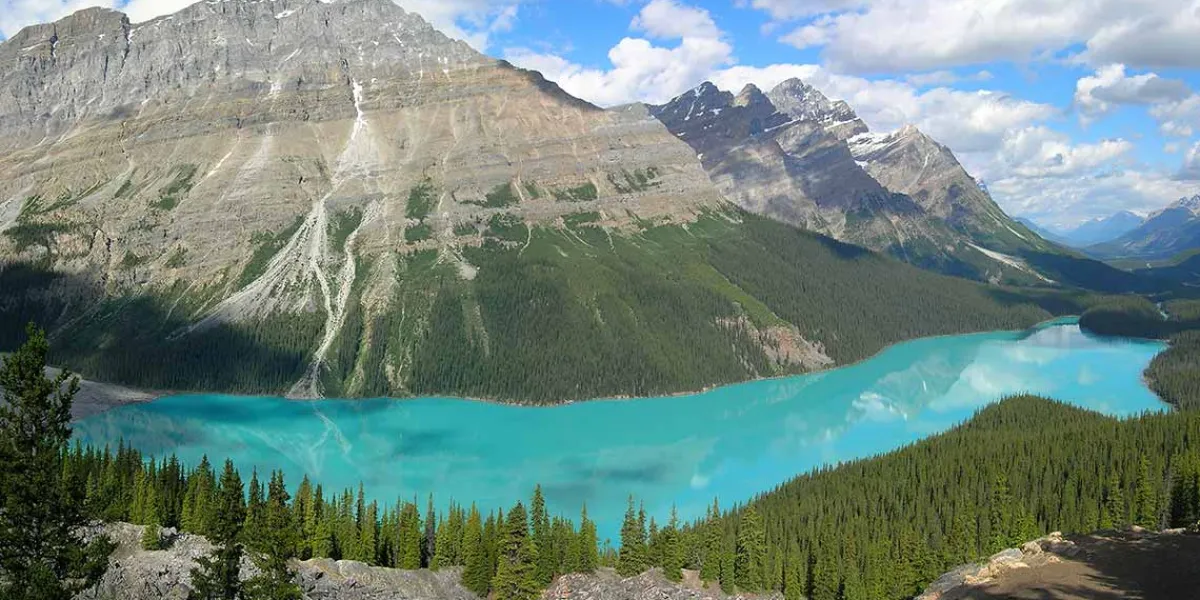
Canada by motorcycle means British Columbia first: roads carved between fjords and glaciers, lakes lined with vineyards and, further east, the Rockies of Banff and Jasper. Distances are big, traffic is light outside Vancouver, and the season is short but magnificent.
You set off from Vancouver, where EagleRider has a location on Shaughnessy Street, in the south of the city. Whistler is 93 km as the crow flies, Vancouver Island is a ferry crossing away, and Seattle, where EagleRider also rents motorcycles, is 195 km away.
Our rental partner in Canada
-
 Eaglerider
The best itineraries in Canada
1 Sea-to-Sky, Whistler and the Duffey Lake loop
- Vancouver
- Squamish
- Whistler
- Pemberton
- Lillooet
- Lytton
- Hope
- Vancouver
The Sea-to-Sky Highway runs along the Howe Sound fjord then climbs to Squamish and Whistler, one of the finest roads in the country. Beyond Pemberton, the Duffey Lake Road strings together hairpins, turquoise lakes and forests all the way to Lillooet.
The return via the Fraser Canyon and Hope closes a varied loop, between mountains and a deep valley. Allow three to four days to ride without hurrying.
- Distance
- about 750 km
- Recommended vehicle
- Tourer or adventure bike, winding mountain roads
2 Vancouver Island, from Victoria to Tofino
- Vancouver
- Tsawwassen
- Victoria
- Duncan
- Port Alberni
- Tofino
- Nanaimo
- Vancouver
The Tsawwassen ferry takes you to Victoria, the provincial capital, with its British charm. The Malahat road then climbs towards the Cowichan Valley, and Highway 4 crosses the island to the wild coast of Tofino and Pacific Rim National Park.
Returning via Nanaimo and the Horseshoe Bay ferry avoids going back the same way. In summer, book the crossings: motorcycles often board first, but the slots fill up.
- Distance
- about 700 km
- Recommended vehicle
- Tourer or roadster
3 The Okanagan and the Rockies to Banff
- Vancouver
- Hope
- Osoyoos
- Kelowna
- Revelstoke
- Golden
- Lake Louise
- Banff
- Kamloops
- Vancouver
Take the Crowsnest Highway to the Osoyoos desert and the Okanagan Valley, with its lakes and vineyards around Kelowna. The road then climbs towards Revelstoke and Rogers Pass, then Golden and Banff National Park, 577 km from Vancouver as the crow flies.
From Lake Louise, the Icefields Parkway to Jasper is a detour well worth making. Allow at least ten days for the round trip.
- Distance
- about 2,200 km
- Recommended vehicle
- Big tourer or adventure bike for the long days
4 Towards Seattle and the North Cascades
- Vancouver
- Bellingham
- Chuckanut Drive
- North Cascades
- Winthrop
- Osoyoos
- Hope
- Vancouver
A loop that crosses the US border: the coast via Bellingham and Chuckanut Drive, then the North Cascades Highway, between glaciers and milky green lakes. Return via the American Okanagan and the Osoyoos border crossing.
This trip requires the rental company's permission to cross the border, insurance valid in the United States and ESTA entry authorisation for travellers who need it. The North Cascades Highway is closed in winter.
- Distance
- about 1,000 km
- Recommended vehicle
- Tourer or adventure bike
When to go in Canada?
June to August, the motorcycle season
In Vancouver, average highs rise from 19 °C in June to 22 °C in July and August, with only 31 mm of rain in July. The Rockies passes and the Duffey Lake Road are clear, and the days are long. It is also the season of full ferries and full accommodation: book early.
May and September, cooler and quieter
Vancouver has a high of 16 °C in May and 18 °C in September. The roads are less busy, but snow can linger or return on the mountain passes: find out about road conditions before heading up to the Rockies. September becomes rainier on the coast, with 120 mm.
October to April, the season of rain and snow
The coast gets most of its rain in autumn and winter: 306 mm in November in Vancouver, with winter highs of 6 °C. The interior passes are snowed in and some roads are closed. It is not a season for travelling by motorcycle.
Where to pick up your motorbike in Canada?
Choose your departure city: the map shows where rental companies hand over their motorbikes.
Renting in Canada, step by step
-
1
Prepare your documents
Passport, an eTA electronic travel authorisation for travellers arriving by air who are subject to it, a valid motorcycle licence and, depending on your country, an international permit. The security deposit is paid by credit card, in the name of the person riding.
-
2
Book the motorcycle in Vancouver
Run the search with your dates: the motorcycles available at the EagleRider location in Vancouver appear with their terms. In summer, book several weeks ahead.
-
3
Book the nights and the ferries
Hotels, motels and lodges are plentiful, but Whistler, Tofino, Banff and Lake Louise are full in summer. Book these stops at the same time as the ferries.
-
4
Get the border crossing approved
To cross into the United States, the rental company's permission and valid insurance are essential. Ask for them before booking, along with the ESTA if it applies to you.
-
5
Return the motorcycle
Allow a margin for Vancouver traffic and possible ferry waits on the last day. The location is in the south of the city, convenient for getting to the airport afterwards.
Everything to know before hitting the road
Helmets mandatory, no lane splitting
Helmets are mandatory for everyone in British Columbia, rider and passenger. Riding between lanes is not permitted. Speeds are in km/h, and mobile speed cameras are common on the main routes.
Ferries: book in summer
Crossings to Vancouver Island are in high demand in July and August, particularly at weekends. Book your passage with the motorcycle and arrive early at the terminal.
Bears, deer and mountain goats
Wildlife often crosses the roads of the Rockies and the north of the province, especially at dawn and dusk. Ride by day, slow down in signposted zones and never stop near a bear.
Mountain weather
You can go from 25 °C in the Okanagan to a few degrees at Rogers Pass on the same day. Bring a warm liner and rain gear, even in midsummer.
Fuel in the interior
Between two towns in the interior or on the Icefields Parkway, fuel stations are rare. Fill up at every opportunity, especially with a modest-sized tank.
Your questions about a road trip in Canada
How many days for a motorcycle road trip in Canada?
Four to five days are enough for Whistler and Vancouver Island. For the Rockies of Banff and Jasper, allow at least ten days from Vancouver, as the distances are big.
What is the most beautiful road from Vancouver?
The Sea-to-Sky Highway to Whistler, extended by the Duffey Lake Road, is the most beautiful road for a day trip. For a big trip, the Icefields Parkway between Lake Louise and Jasper is one of the most spectacular mountain roads in North America.
Can I combine Canada and the United States?
Yes, Seattle is only 195 km away as the crow flies, and EagleRider has a location there too. You do, however, need the rental company's permission and insurance that covers both countries; a one-way rental from one to the other depends on availability.
Can I ride as far as the Rockies?
Yes, Banff is about two days' ride from Vancouver via the Okanagan or the Trans-Canada Highway. Allow for the national park entry fee and check that the roads are open at the start and end of the season.
FAQ — Motorcycle rental in Canada
Is a helmet mandatory?
Yes, for the rider and the passenger alike, everywhere in Canada. Check when booking whether the location provides a helmet, or bring your own if it is approved.
Is my motorcycle licence valid?
For a tourist stay, British Columbia in principle recognises a valid foreign motorcycle licence; depending on the issuing country, an international permit is recommended. The rental company's requirements are stated in the offer.
Do I need authorisation to enter Canada?
Visa-exempt travellers arriving by air must obtain an eTA electronic travel authorisation before departure. Check the conditions for your nationality.
Where do I sleep during the trip?
In hotels, motels and lodges, which are plentiful in Whistler, the Okanagan and the Rockies. In summer, book the most popular stops in advance and check that parking is provided for the motorcycle.
Do the national parks charge an entry fee?
Yes, Banff, Jasper and the other Rocky Mountain parks charge a Parks Canada entry fee. For several days or several parks, an annual pass is often better value.
Why take a motorcycle trip in Canada
Between ocean, forests and mountains, British Columbia offers some of the most beautiful roads in North America, with little traffic and landscapes of great variety: the Sea-to-Sky fjords, the Okanagan vineyards, the glaciers of the Rockies.
From Vancouver, you choose between a loop of a few days to Whistler and Vancouver Island or a big trip to Banff. All you need to do is travel in summer, book ferries and nights in advance, and stay alert for wildlife.